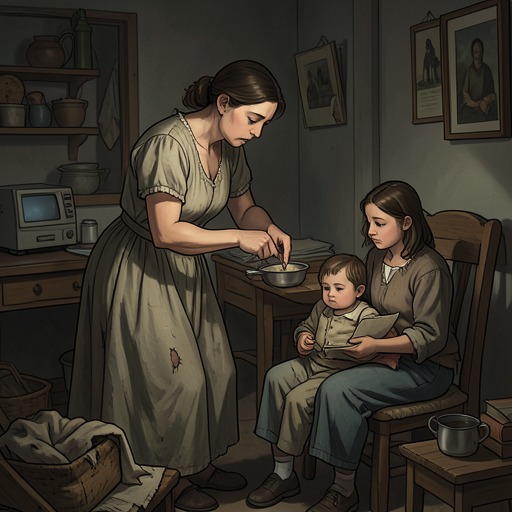
Mrs Ramsay dies
To the LighthouseMrs Ramsay dies suddenly during the night, an offstage event whose force is registered through the empty space she leaves behind. Her death interrupts ordinary family time, becomes one of the absences around which the novel’s middle section turns, and persists in the house and in the memories of those who knew her.
The Death and Its Immediate Absence
The event is conveyed in a brief passage: one dark morning, Mr Ramsay stumbles along a passage and stretches out his arms, but they remain empty because Mrs Ramsay died suddenly the night before. The narration gives no account of the circumstances of her death. Instead, it makes the loss legible through a familiar gesture that can find no one to receive it.
That abrupt statement follows an account of nights marked by wind and destruction. The house and landscape offer no reassuring answer to human solitude; against that impersonal disorder, Mr Ramsay’s empty arms make bereavement a private fact without turning it into a dramatic scene. The novel’s restraint places the reader beside the consequence rather than inside an explanation of the death.
A Life of Care, Seen in Retrospect
Before her death, Mrs Ramsay’s attention repeatedly moves toward the needs and vulnerabilities of others. She knits a reddish-brown stocking for the lighthouse keeper’s young son, whose hip is threatened by tuberculosis, and considers sending the family magazines, tobacco, and other useful comforts. Her concern extends beyond her household: she imagines the isolation of life on a small rock and the hardships of storms and separation.
Her practical sympathy also appears in her anger about the absence of a hospital on the island and the poor quality of delivered milk. She imagines establishing both a model dairy and a hospital, but recognizes that the demands of raising her children leave little time for such work. The contrast between these public ambitions and the limited means available to her helps define the care through which her presence had shaped everyday life.
That care is not free of tension. Mrs Ramsay remembers an accusation that she interfered in other people’s lives and tried to take a daughter’s affections. She considers the charge unjust, while acknowledging how strongly she feels about practical matters and how readily she wants others to see their importance. Her death thus leaves behind not a simplified emblem of domestic kindness but the memory of a person whose solicitousness could be generous, forceful, and contested.
War, Nature, and the Wider Loss
Mrs Ramsay’s death belongs to a period in which the family’s private losses are set against the First World War. The narration reports that a shell exploded in France and killed twenty or thirty young men, including Andrew Ramsay; his death was instantaneous. The event is reported with the same spare directness that marks Mrs Ramsay’s death, though the two losses occur in different circumstances.
The war intrudes upon the seascape as well as the family’s history. A silent ship appears and disappears, and a purplish stain interrupts the sea’s calm surface. These signs unsettle the idea that natural beauty can complete or console human experience. The narration asks whether nature supplements what people make and concludes that it witnesses misery and suffering with equal composure. Against this landscape, bereavement cannot be resolved by treating beauty as an answer.
Memory in the Empty House
Years later, Mrs McNab finds the summer house neglected and its cupboards still holding the family’s clothes. She touches Mrs Ramsay’s old grey gardening cloak and recalls her coming up the drive with the washing and one of the children beside her. Shoes, a brush and comb, handkerchiefs, and bits of ribbon remain in place, as though their owner might return. The objects preserve routines without undoing the fact of her death.
The family has not returned for years; Mrs McNab has heard that Mrs Ramsay died suddenly in London. The gap between the abandoned belongings and this plain report gives domestic absence its duration. What remains in the house is not a restored presence but material evidence of a life once organized around rooms, children, and daily work.
Grief as Partial Knowledge
Lily Briscoe later thinks of Mrs Ramsay through her memory of Augustus Carmichael’s response to Andrew’s death. She has heard that he lost interest in life, but does not know what he did when the news reached him. She nevertheless feels that his grief changed him. Her reflection suggests a way of knowing another person through outlines and changes rather than complete access to private feeling.
That partial knowledge also shapes the novel’s treatment of Mrs Ramsay’s death. The event is decisive, but the narrative does not supply a final explanation of its circumstances or make grief wholly transparent. It returns instead through an empty gesture, neglected belongings, and the altered lives of survivors. The death marks the fragility of the family’s shared world while showing how care and attachment continue to be apprehended through memory.